
Chicken Tetrazzini
Dried spaghetti, shredded rotisserie chicken meat and cremini mushrooms, sliced come together in this chicken — 75 minutes, 7 steps, and the kind of result worth repeating. Below: the ingredients split into pantry staples and a quick shopping list, a built-in serving scaler, and the method in 7 steps.
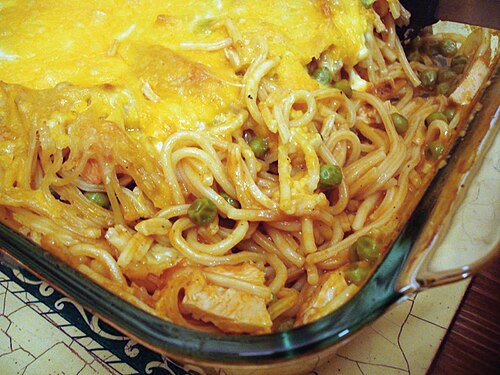
You'll mainly reach for oven and frying pan / skillet. At medium difficulty across 7 steps, it's manageable with a little attention.
What you'll need
Shopping list (8)
Pantry staples (you likely have these)
Diet: contains meat, based on every ingredient listed below.
Contains: Gluten Dairy
Allergen labels are informational and may not cover cross-contact; verify every package and consult a qualified professional for medical dietary needs. Diet labels are derived from the ingredient list on this page — how we verify diet and allergen labels.
Food-safety and allergen information is general, not medical advice. Follow current guidance from your local food-safety authority, verify product labels, and seek qualified advice for allergies or health conditions.
How to make it
- Preheat the oven to 190 C and butter a large baking dish, then bring a pot of salted water to the boil and cook the spaghetti about 2 minutes short of al dente, since it will finish baking; drain and set aside.
- Melt the butter in a large skillet over medium-high heat, add the mushrooms and a pinch of salt and cook until they release their liquid and turn golden, about 7 minutes, then add the onion and thyme and soften for 3 minutes.
- Sprinkle the flour over the vegetables and stir constantly for 1 to 2 minutes to cook out the raw taste, then gradually whisk in the chicken stock followed by the milk, stirring until smooth.
- Simmer the sauce, stirring often, until it thickens enough to coat a spoon, about 5 minutes, then stir in the cream, sherry and half of the parmesan and season well with salt and pepper.
- Remove from the heat and fold in the shredded chicken, the peas and the drained spaghetti until everything is evenly coated, then transfer to the prepared baking dish.
- Toss the panko with the remaining parmesan and a little melted butter, scatter it over the top, then bake for 20 to 25 minutes until the sauce is bubbling at the edges and the crumb topping is golden brown.
- Let the tetrazzini rest for 5 minutes so the sauce sets slightly, then garnish with extra thyme and serve hot.
You'll use: Oven · Frying pan / skillet · Pan · Large pot · Saucepan
Ingredient substitutions
- Butter
- olive oil (¾ the amount) · coconut oil · margarine
- Milk
- any unsweetened plant milk · ½ cup evaporated milk + ½ cup water
- Heavy Cream
- evaporated milk · ½ cup milk + ¼ cup melted butter · full-fat coconut milk
- Parmesan
- pecorino · grana padano · aged asiago
Tips & common questions
How long does Chicken Tetrazzini take to make?
About 75 minutes from start to finish — an estimate based on the 7 steps and 16 ingredients. Times vary with your kitchen and how much prep you do ahead.
What can I use instead of butter?
Try olive oil (¾ the amount). See the substitutions section above for more swaps.
Can I scale this recipe up or down?
Yes — use the servings control above the ingredients and every quantity rescales automatically (fractions included). Cooking times stay roughly the same; very large batches may need a little longer.
How should I store leftovers?
Cool leftovers quickly, refrigerate in an airtight container, and eat within 3 days. Reheat until piping hot throughout.
Related recipes

Adapted recipe — rewritten in our own wording from an open-licensed community cookbook, not yet independently kitchen-tested by Consomee. How we source, test & correct recipes.
Chicken Tetrazzini is adapted by Consomee from the Wikibooks Cookbook, rewritten in our own wording and used under CC BY-SA 4.0. Photo: Turkey Tetrazzini.jpg by CityMama --Stefania Pomponi Butler, CC BY-SA 2.0 via Wikimedia Commons. We add the serving scaler, ingredient tools, timing and structure — how we source recipes.