
Koshari
Brown lentils, rice and coriander come together in this Egyptian vegetarian — 115 minutes, 18 steps, and the kind of result worth repeating. Below: the ingredients split into pantry staples and a quick shopping list, a built-in serving scaler, and the method in 18 steps.
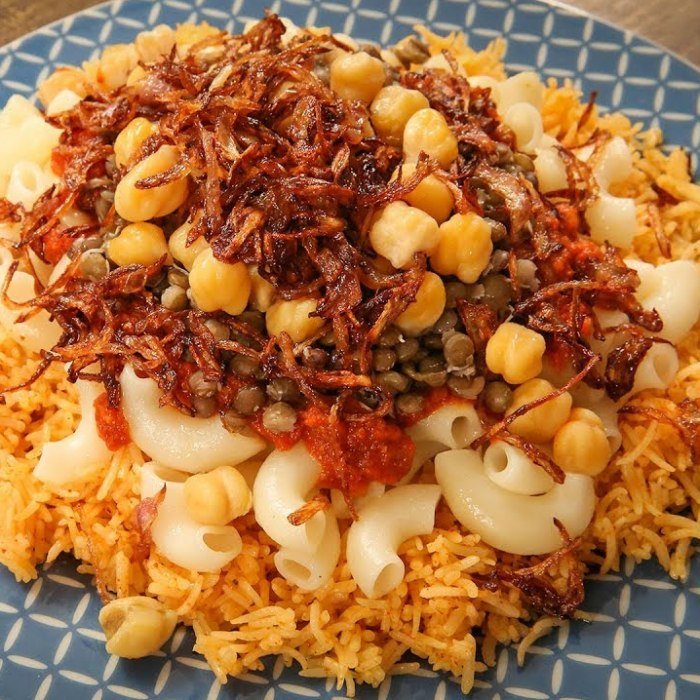
You'll mainly reach for frying pan / skillet and saucepan. At involved difficulty across 18 steps, it's worth setting aside proper time for. As written, every ingredient resolved to a plant source.
What you'll need
Shopping list (5)
Pantry staples (you likely have these)
Diet: vegan — no meat, fish, dairy, egg or honey, based on every ingredient listed below.
Contains: Gluten
Allergen labels are informational and may not cover cross-contact; verify every package and consult a qualified professional for medical dietary needs. Diet labels are derived from the ingredient list on this page — how we verify diet and allergen labels.
Food-safety and allergen information is general, not medical advice. Follow current guidance from your local food-safety authority, verify product labels, and seek qualified advice for allergies or health conditions.
How to make it
- Cook the lentils.
- Bring lentils and 4 cups of water to a boil in a medium pot or saucepan over high heat.
- Reduce the heat to low and cook until lentils are just tender (15-17 minutes).
- Drain from water and season with a little salt. (Note: when the lentils are ready, they should not be fully cooked.
- They should be only par-cooked and still have a bite to them as they need to finish cooking with the rice).
- Now, for the rice.
- Drain the rice from its soaking water.
- Combine the par-cooked lentils and the rice in the saucepan over medium-high heat with 1 tbsp cooking oil, salt, pepper, and coriander.
- Cook for 3 minutes, stirring regularly.
- Add warm water to cover the rice and lentil mixture by about 1 1/2 inches (you’ll probably use about 3 cups of water here).
- Bring to a boil; the water should reduce a bit.
- Now cover and cook until all the liquid has been absorbed and both the rice and lentils are well cooked through (about 20 minutes).
- Keep covered and undisturbed for 5 minutes or so.
- Now make the pasta. While the rice and lentils are cooking, make the pasta according to package instructions by adding the elbow pasta to boiling water with a dash of salt and a little oil. Cook until the pasta is al dente. Drain.
- Cover the chickpeas and warm in the microwave briefly before serving.
- Make the crispy onion topping.
- Sprinkle the onion rings with salt, then toss them in the flour to coat. Shake off excess flour.
- In a large skillet, heat the cooking oil over medium-high heat, cook the onion rings, stirring often, until they turn a nice caramelized brown. Onions must be crispy, but not burned (15-20 minutes).
You'll use: Frying pan / skillet · Saucepan · Pan · Large pot · Microwave
Watch how it's made

Hosted on YouTube — pressing play loads content from YouTube.
What to serve with Koshari
- Shawarma Chicken
- Mulukhiyah Beef
- Feteer Meshaltet Side
- Egyptian Fatteh Beef
Tips & common questions
How long does Koshari take to make?
About 115 minutes from start to finish — an estimate based on the 18 steps and 8 ingredients. Times vary with your kitchen and how much prep you do ahead.
Can I scale this recipe up or down?
Yes — use the servings control above the ingredients and every quantity rescales automatically (fractions included). Cooking times stay roughly the same; very large batches may need a little longer.
Is Koshari vegan?
Every ingredient listed on this page resolved to a plant or mineral source in our ingredient ontology — no meat, fish, shellfish, dairy, egg or honey. Labels can still differ by brand, so check packaged items.
Related recipes






Structured source recipe — not yet independently kitchen-tested by Consomee. How we source, test & correct recipes.
Recipe data for Koshari via TheMealDB (open database). ▶ Video. Original source. Consomee adds the scaler, ingredient tools, timing and structure — how we source recipes.